Can I Drive Up To Mount John Observatory?
Daytime you can drive the Mount John road for a small per-vehicle fee, but at night the road is closed and the summit is reachable only on the Dark Sky Project coach tour. Here is how access works.
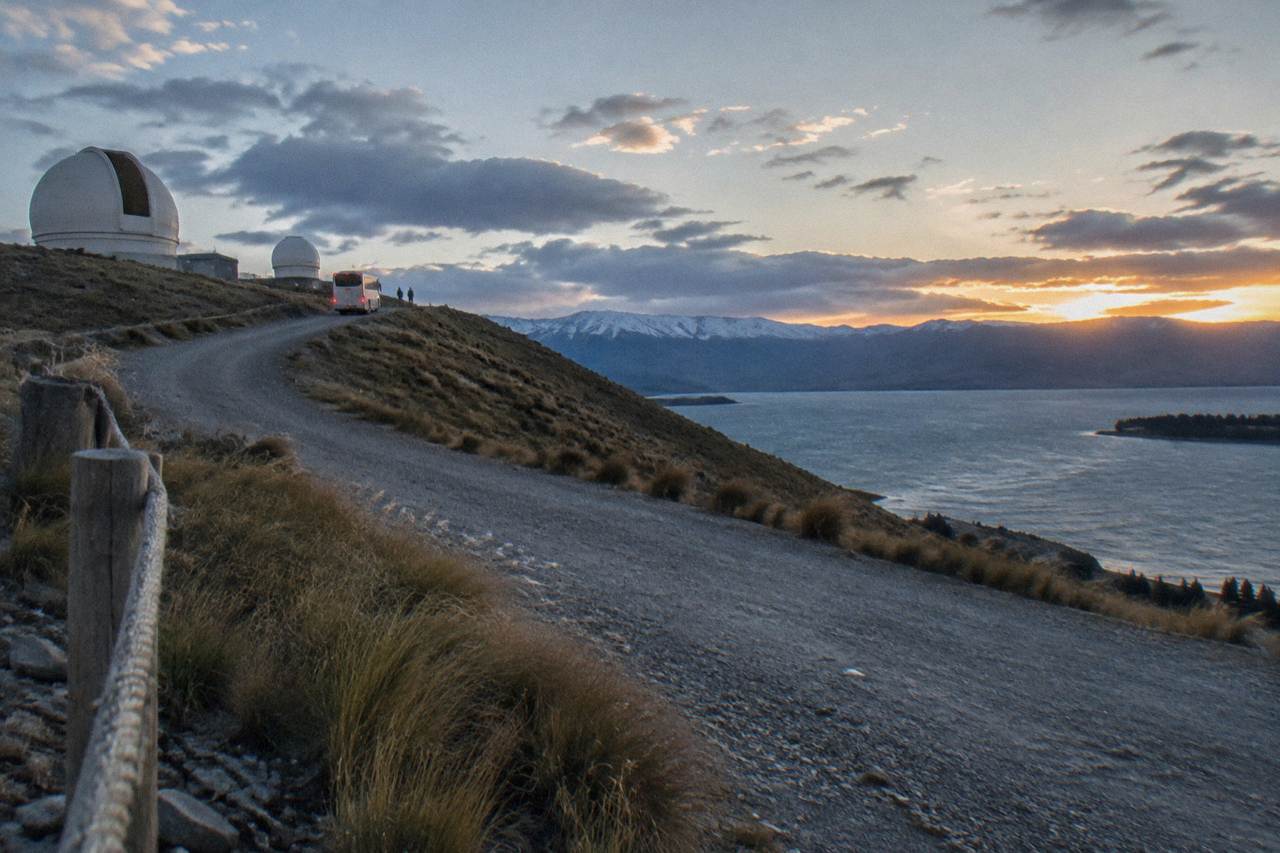
Mount John rises beside Lake Tekapo village, and its summit carries the University of Canterbury's research observatory, New Zealand's largest professional research facility, with four research-grade telescopes in continuous scientific use. The question of driving up has a split answer, and the split is the single most useful thing a visitor to Lake Tekapo can learn before planning an evening. In the daytime, yes: a private access road climbs about 15 minutes from the village to the summit, open to ordinary cars with a small per-vehicle fee paid at the gate. At night, no: after dark the road is not an option for visitors, and evening access to the summit is the Dark Sky Project coach only. Since the coach is the only way up after dark, many visitors weigh it against a second Dark Sky Project option, and the guide to the Cowan's Observatory Crater Experience lays out how the two evenings differ.
That split exists for good reasons, and it shapes how almost every stargazing trip in the village actually works. This page walks through the daytime road, the night closure, the coach tour that holds the only evening keys, and the other Lake Tekapo stargazing tours that never need the mountain road at all.
Can I Drive Up To Mount John Observatory In The Daytime?
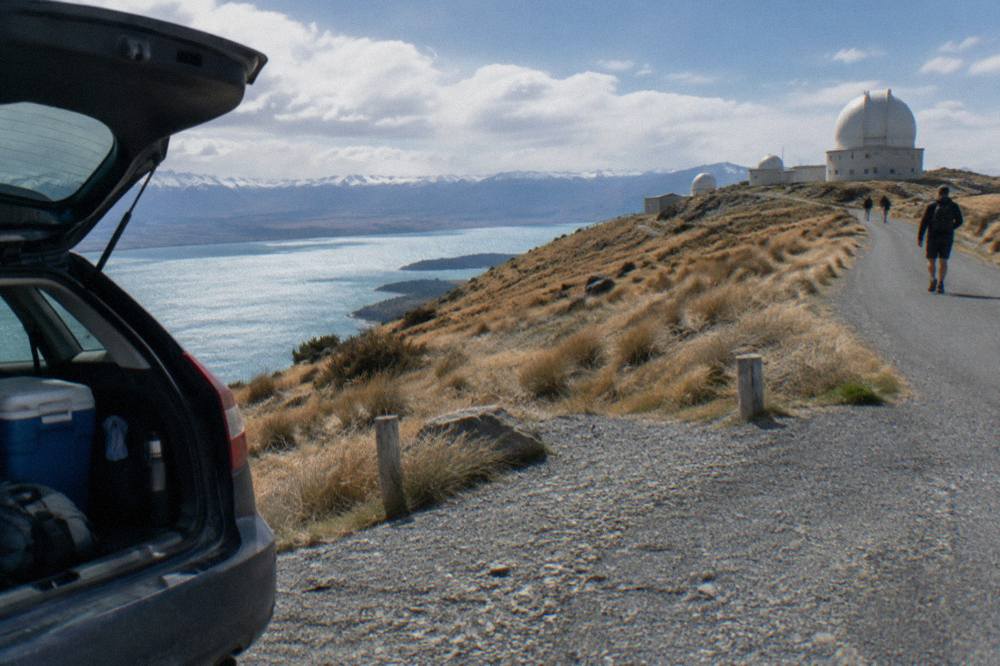
Yes, in the daytime private vehicles can drive the Mount John access road, a drive of about 15 minutes from Lake Tekapo village, with a small per-vehicle fee paid at the gate. The road serves the Astro Cafe and the summit lookout, both open in the daytime. Vehicles over 12 seats are not allowed, and the road is not a night option: after dark, summit access runs through the Dark Sky Project coach.
The daytime drive is one of the quiet pleasures of a Lake Tekapo visit. The road climbs tussock slopes above the lake, and the summit lookout gives a full panorama across the turquoise water, the village and the Mackenzie Basin beyond. The Astro Cafe at the top has made the mountain almost as famous for coffee as for stars, and daytime visitors arrive by car, camper and bicycle through the morning and afternoon.
Two practical limits matter. The first is the gate fee: it is small, it is per vehicle, and it is paid at the gate, with no need to book anything in advance. The second is size. Vehicles over 12 seats are not allowed on the road, which rules out most coaches and larger campervan convoys arranging their own ascent; those groups use other arrangements. Ordinary rental cars and small campervans are fine.
It is worth being clear about what the daytime drive does not give you. Daytime is daylight, and the observatory telescopes are research instruments, not a public viewing facility you can walk up to and look through. The daytime visit is about the view, the cafe and standing at 1,029 metres. The night sky above Mount John is a different experience entirely, and it has a different access rule, which is where most confusion starts.
Why Can't You Drive Up Mount John At Night For Stargazing?
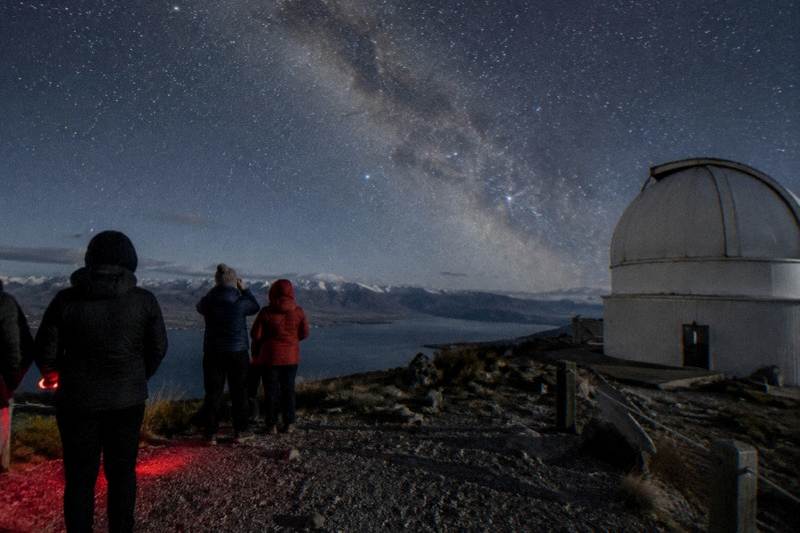
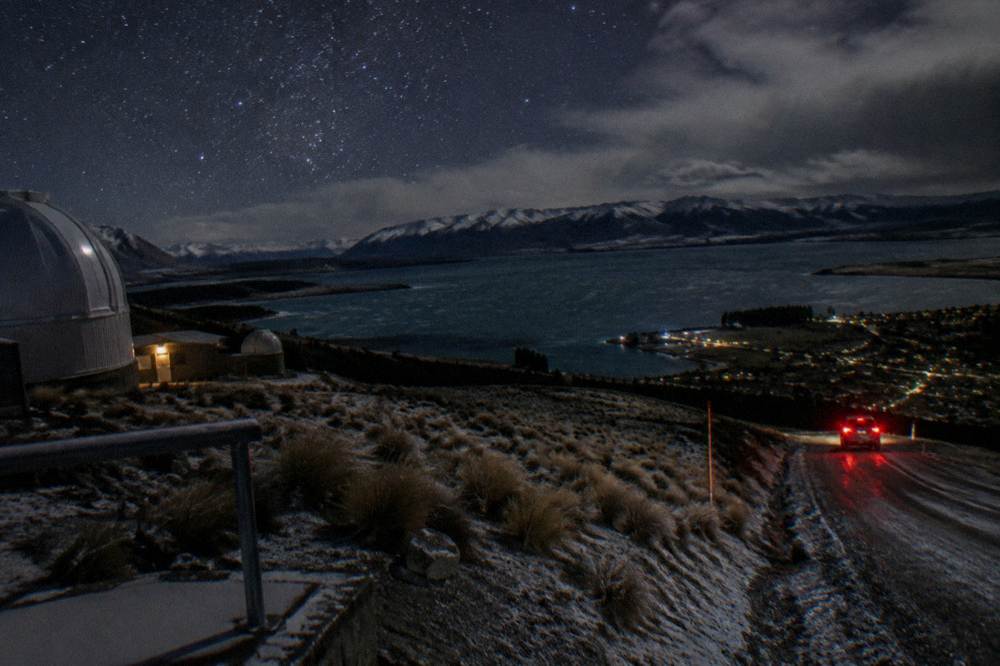
After dark the Mount John road is closed to visitor traffic, and evening access to the summit is by the Dark Sky Project Summit Experience coach only. The reason is the darkness itself: headlights, parked cars and stray light interfere with research telescopes and with the dark sky the whole area protects. A private vehicle on the summit at night would undo both.
Mount John is a working research station first and a visitor destination second. The University of Canterbury runs its four research-grade telescopes there through the night, and the observatory's value depends on keeping the immediate surroundings genuinely dark. A stream of private cars arriving after dusk, with headlights sweeping the summit and dome doors opening, would degrade the very conditions the instruments need. The same logic protects the stargazing experience for everyone on the mountain.
There is a wider frame too. Mount John sits inside the Aoraki Mackenzie International Dark Sky Reserve, designated in 2012 and covering 4,367 square kilometres of the Mackenzie Basin and Aoraki / Mount Cook National Park, the largest dark sky reserve in the Southern Hemisphere. District plan lighting rules apply across the reserve. Closing the summit road at night is part of the same culture of protecting darkness rather than just admiring it. DarkSky International lists the reserve among its International Dark Sky Reserves, and the practical effect for a traveller is simple: darkness is managed here, deliberately, and the mountain road at night is one of the managed parts.
So the closure is not a ticketing trick or an upsell. It is how a research observatory inside a dark sky reserve has to operate. For visitors, that leaves one legitimate evening route to the summit, and a set of excellent alternatives lower down that never touch the mountain road.
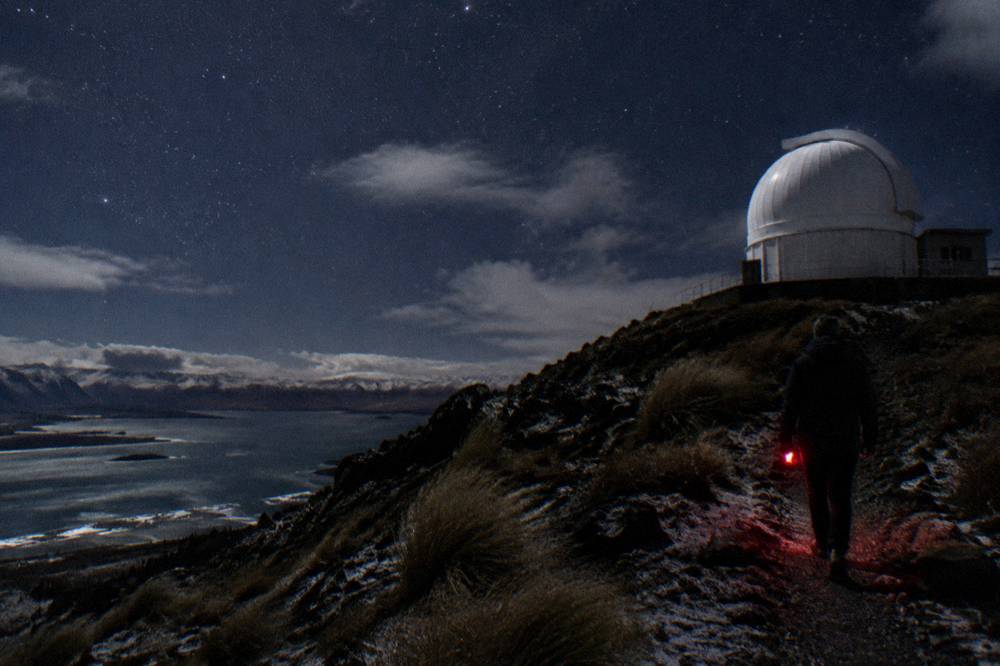
If standing on the summit at night is the goal, the coach tour that holds the evening access is worth a look while dates are still open, since tours often sell out and same-day booking, while sometimes possible, is not something to rely on.
How Do You Get Up Mount John At Night?
The Mount John Summit Stargazing Experience, run by Dark Sky Project, is the evening route to the summit: 1 hour 45 minutes from $135.00 per person, rated 4.6 across 348 reviews, coach transport included at about 15 minutes each way. You check in at the Dark Sky Project base at 1 Motuariki Lane on the Tekapo lakefront, about 15 to 20 minutes before departure.
The Summit Experience is the tour that turns the night closure from an obstacle into an itinerary. A coach takes the road that private cars cannot use after dark, climbing to the 1,029 metre summit where the group uses naked-eye viewing with guide lasers, telescopes, and a 16 inch telescope inside the observatory dome. The minimum age is 10, and an extreme cold weather jacket is loaned on the Summit, which matters: the summit has high wind exposure and often snows in winter, and it is cold at night even in summer.
Fitness and access are honest constraints worth knowing before booking. The tour involves moderate fitness, a 100 metre gravel incline plus a few steps in the dark, and it is not wheelchair accessible. Photos are allowed with the flash off, and guides share astrophotography tips, so a camera is worth carrying if you have one. Beyond the jackets, dress for the conditions: Dark Sky Project's own clothing advice runs to thermals, long pants, a jersey, jacket and hat in summer, and thermals, snow jacket, gloves, scarf, hat and sturdy ankle-covering shoes in winter. More detail on dressing for a Tekapo night is in the guide to what to wear on a stargazing tour.
Weather is decided by the operator close to departure. Dark Sky Project's own policy is that the team decides as late as possible, forecasts are indicative, and low cloud is often blocked by the basin's topography, so cloud alone does not always cancel. If outdoor stargazing is not possible, guests are offered an indoor alternative, a reschedule, a voucher or a refund. All 12 booking pages for the tours covered here state free cancellation up to 24 hours before the start for a full refund, which is a booking rule, not a weather promise.
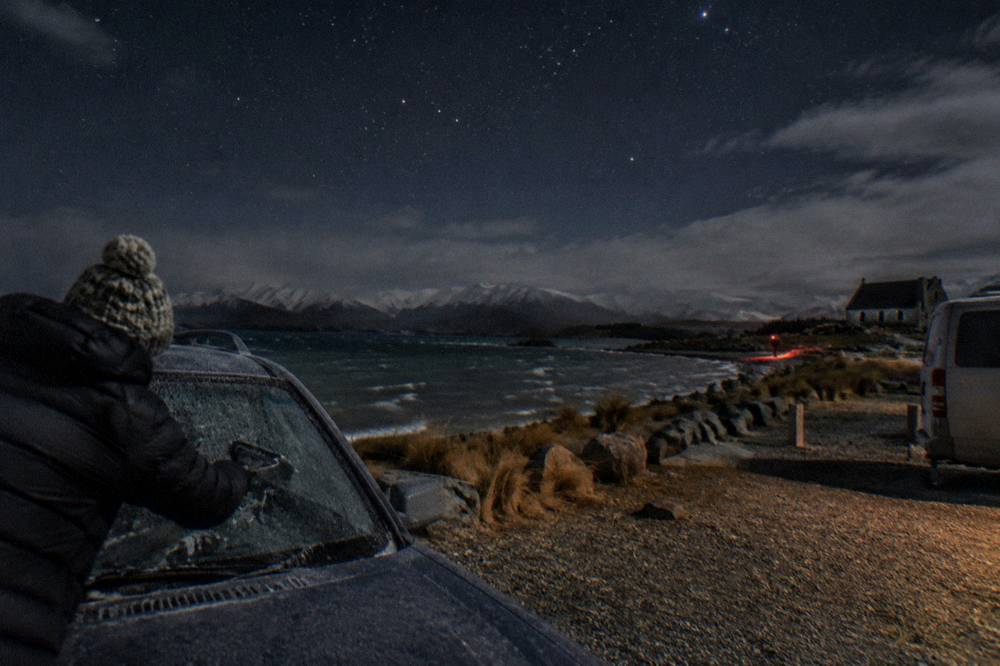
Is There A Dark Sky Project Tour That Doesn't Go Up Mount John?
Yes, the Crater Stargazing Experience at Cowan's Observatory runs 75 minutes from $78.00 per person, rated 4.6 across 91 reviews, meeting at the same 1 Motuariki Lane base. It travels about 5 minutes by coach to purpose-built observation craters at Cowan's Private Observatory, which shelter viewers from wind and light, with 14 inch telescopes and a dome.
The Crater Experience is the natural fallback, and for many visitors it is not a fallback at all but the better choice. It is shorter, cheaper, and its minimum age is 5 rather than 10, which opens it to younger families the Summit tour cannot take. The observation craters are private to the site, so the darkness is protected, and the wind shelter makes a real difference on the cold nights the Mackenzie Basin specialises in. The trade is altitude and the summit view: you stay low in the basin rather than standing above it.
Access notes differ in one useful way. Wheelchair users can take part in the Crater Experience by following the coach in their own vehicle, where the Summit tour is not wheelchair accessible. Jackets are not stated for the Crater tour, so dress warmly in your own layers. The same operator's weather policy applies, with an indoor alternative, reschedule or full refund offered if the sky does not cooperate.
There is also a fully indoor option from the same operator. The Indoor Dark Sky Cultural Astronomy Experience is a 45 minute guided walk through four zones at 1 Motuariki Lane, from $34.70 per person, rated 4.4 across 80 reviews, with a restored 125 year old Brashear telescope on display and a focus on Maori understanding of the sky. It is an exhibit, not stargazing: there is no outdoor sky viewing, and it is best treated as a cultural and historical complement to a night tour, or as a cloudy-evening plan. The comparison between the two outdoor Dark Sky Project options is covered in detail in Summit versus Crater compared.
| Question | Daytime road | Summit Experience at night | Crater Experience at night |
|---|---|---|---|
| Own car allowed? | Yes, small per-vehicle fee at the gate | No, coach only | No, coach from the base |
| Start point | Lake Tekapo village | 1 Motuariki Lane, Tekapo lakefront | 1 Motuariki Lane, Tekapo lakefront |
| Duration | About 15 minutes' drive | 1 hour 45 minutes | 75 minutes |
| From price | Gate fee only | $135.00 per person | $78.00 per person |
| Minimum age | None stated | 10 | 5 |
| Jackets | Not applicable | Loaned on the Summit | Not stated |
Can You Stargaze At Lake Tekapo Without Any Observatory Access?
Yes. Independent operators run outdoor stargazing at private and public sites around the village with no Mount John road and no observatory dome, among them the Alpine Stargazing Experience with a Guide from $56.00 per person, 1 hour 15 minutes, rated 4.6 across 864 reviews, on a private 50,000 acre farm with 14 inch telescopes and astro-lasers, group maximum 10.
The Alpine tour, run by Silver River Stargazing, checks in about 15 minutes early at Kiwi Treasure, the Lake Tekapo information centre at 12 Rapuwai Lane, then shuttles to its farm site. Chairs, telescopes and warm down jackets are provided, and a complimentary digital photo is included. Its own cloud policy is reschedule or refund by preference and availability. For a reader whose real question is do I need the observatory at all, this is the clearest no: a telescope, a guide and a genuinely dark site, reached without touching Mount John.
Other options spread wider still. Chameleon Stargazing meets at 70 Andrew Don Drive, a 4 minute drive or about 25 minute walk from the village, and runs 90 minutes from $73.00 per person, rated 4.9 across 789 reviews, the second most reviewed tour of the 12 covered here, with a 9.25 inch telescope plus a smart telescope, hot chocolate and marshmallows, a digital souvenir photo, group maximum 14 and minimum age 5. Astro Tekapo meets at its own stargazing site in Takapo Regional Park, 4 minutes by car or about 25 minutes on foot, from $59.00 per person, with a premium 9.25 inch telescope, a smart telescope, hot chocolate, a moon chair and a fleece blanket; its policy offers a full refund if sky conditions are too cloudy for stargazing. There are also free spots around the lake for anyone happy to skip the telescope, covered in the guide to free stargazing spots at Lake Tekapo.
The full spread of options, prices and trade-offs across all the Tekapo operators is laid out in Lake Tekapo stargazing tours compared, which is the right next stop if the choice is between several evenings rather than one.
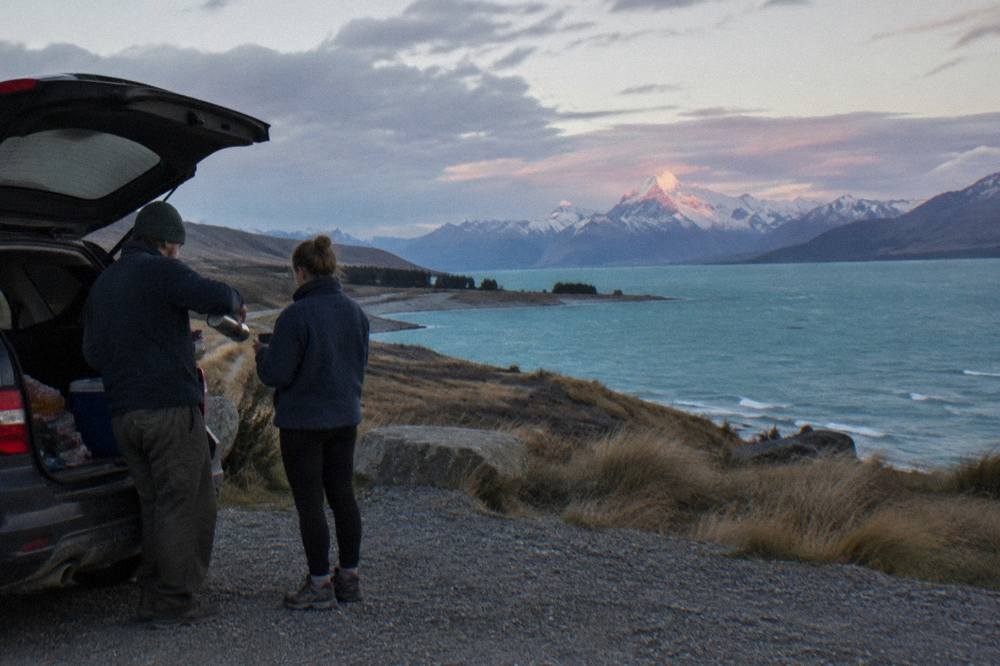
How Do You Get To Lake Tekapo And Mount Cook For A Stargazing Night?
Lake Tekapo is about three hours by road from both Christchurch and Queenstown on the main highway, and Mount Cook village is about 1 hour 15 minutes by road from Tekapo. Four of the 12 tours covered here start outside Tekapo entirely: the Mt Cook Stargazing Experience meets at Tasman Glacier Car Park in the national park, from $56.00 per person, and three tours meet in Twizel, which sits between Tekapo and Mount Cook.
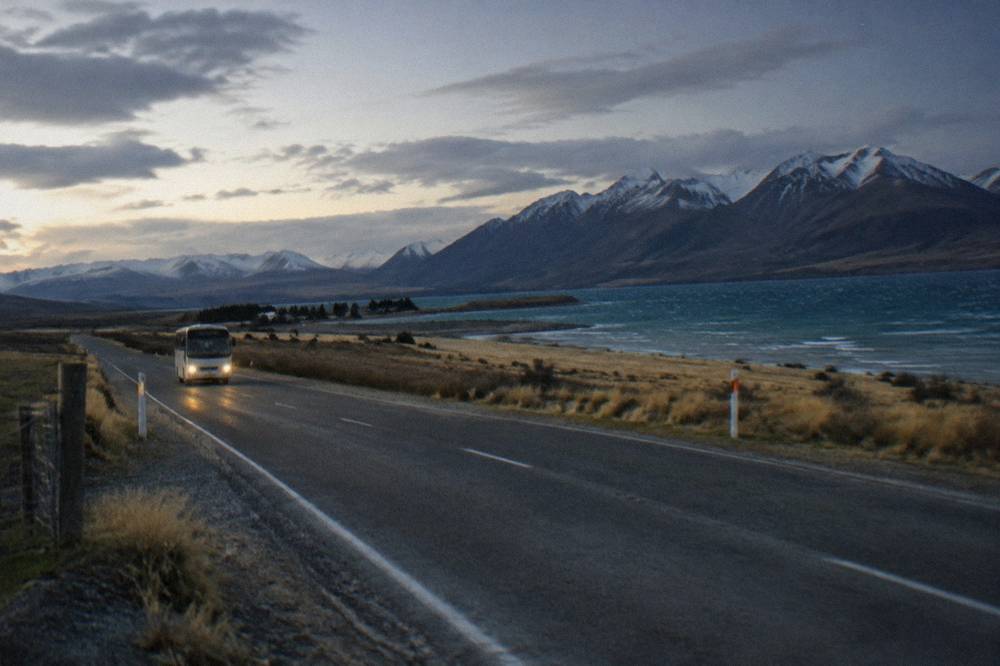
Those start points matter for anyone mixing destinations. The Mt Cook tour, rated 4.8 across 17 reviews, is the same Silver River family of operators as the Alpine tour, with high-quality telescopes for deep sky observation and a photo included, but you drive yourself to the Tasman Glacier Car Park; there is no transfer from Tekapo implied. In Twizel, the Twizel Stargazing Tour with an Astronomer and Telescope from Stargaze Mackenzie runs from $67.00 per person, rated 5.0 across 77 reviews, minimum age 6, with a laser-guided tour and a photo included, and runs only in clear conditions with a refund or reschedule if cancelled for weather. The Twizel Stargazing Experience with a Guide meets at the Distinction Mackenzie Country Hotel, from $68.23 per person, group maximum 20, and the Zen Stargazing Experience is a Japanese-language tour from $56.00 per person meeting at Market Place, Twizel; it is a new listing with no reviews yet, so there is no rating to report. The Hermitage also runs its own Big Sky Stargazing in the national park, outside the tours covered here, as a neighbouring option.
Winter and night driving deserve respect. At night the highways to Tekapo and Mount Cook can carry black ice, frost, freezing fog and stock or wildlife on the road in the cold months, and the NZTA Journey Planner at journeys.nzta.govt.nz is the place to check conditions before any night drive. The district plan lighting rules that keep the reserve dark also mean road lighting is minimal once you leave the villages, which is excellent for stars and demanding for drivers. Plan to arrive at any check-in point early rather than racing a departure time.
What Time Do Stargazing Tours Actually Leave At Mount John?
Departure times follow the darkness, and in the New Zealand summer that means very late starts: astronomical darkness at Tekapo begins between about 22:22 and 23:24 in November 2026, and between 23:26 and 23:54 in December. In midwinter the same darkness begins around 18:56, so the same tour runs hours earlier. Check in at the Dark Sky Project base 15 to 20 minutes before departure.
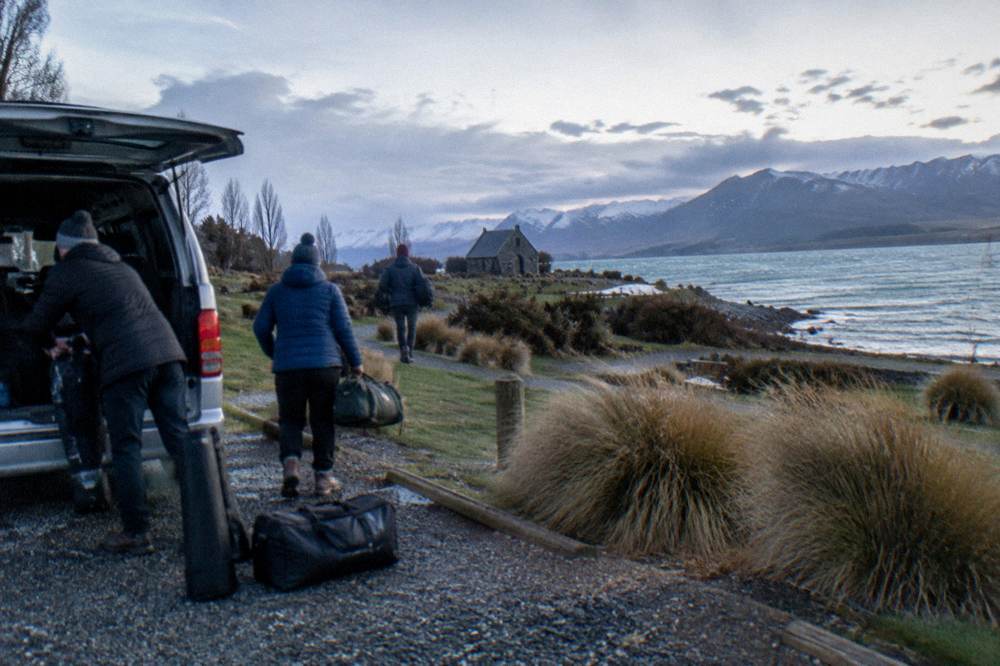
No operator publishes a fixed clock schedule that holds across seasons, and any specific departure time you read anywhere should be treated as a snapshot. What is fixed is the astronomy. Astronomical darkness, when the Sun is more than 18 degrees below the horizon, is what stargazing tours wait for, and at Tekapo's latitude that arrives late in summer and early in winter. The deepest summer months give only 3.5 to 4 hours of true darkness per night in December, while June delivers 11.3 to 11.5 hours.
The Moon moves the needle just as much. A new moon gives the darkest sky, and a full moon washes out faint stars and the Milky Way, as Dark Sky Project's own FAQ puts it. In November 2026 the new moon fell on 9 November and the full moon on 25 November, with 13 of the month's 30 nights offering three or more moon-free dark hours. None of this promises a clear or moonless night for any given date, but it does tell you which nights have the best raw ingredients. The computed detail is in the moon phase calendar for Lake Tekapo, and the seasonal trade-offs are unpacked in winter versus summer stargazing.
Should You Book A Mount John Tour Before You Arrive?
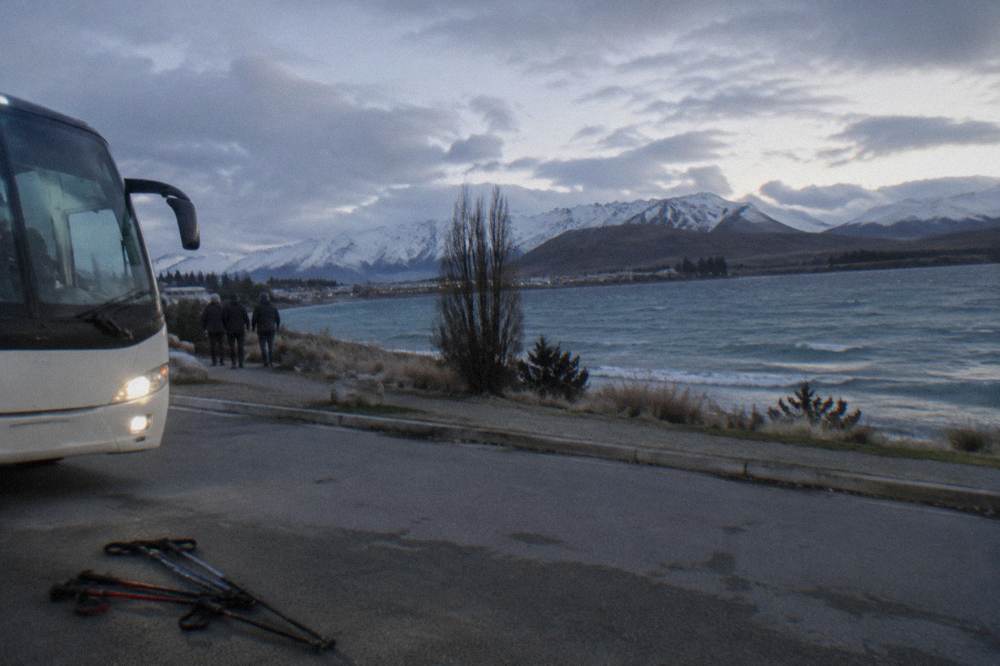
Booking ahead is the safer play. Dark Sky Project says same-day booking can be possible but tours often sell out, and the Summit Experience is the only evening route to the mountain, so there is no like-for-like substitute once it fills. All 12 booking pages for the tours covered here state free cancellation up to 24 hours before the start for a full refund, which softens the risk of committing early.
The practical pattern most visitors land on is this: pick your night or nights before travelling, book the tour that fits your group's ages and budget, and keep the 24 hour cancellation window in mind if your itinerary is loose. Ages matter more here than people expect. The Summit tour's minimum age is 10 and the Hot Pools and Stargazing night is also 10, the Crater and Chameleon tours take age 5, Astro Tekapo takes 6, and Stargaze Mackenzie takes 6, so the children in your party can decide the question before price does. Group sizes cap at 10 on Alpine, Ultimate and Astro Tekapo, and at 14 on Chameleon and 20 on the Twizel Experience, and small caps plus sell-outs plus a short summer darkness window is exactly the combination that punishes walk-up hopes.
A backup plan for cloud is worth five minutes of thought too. Dark Sky Project's policy offers an indoor alternative, reschedule or refund when the sky fails; Astro Tekapo offers a full refund if conditions are too cloudy; the Hot Pools night runs even when cloud limits telescopes, with an indoor virtual reality session, the pools still included, and a 25 percent refund if under 30 minutes of telescope viewing happens. Knowing which of those you would prefer tells you which tour to book. This site, Lake Tekapo Stargazing, exists to make exactly that kind of comparison quick, and the operator detail behind each policy is in the guide to weather and cloud cancellations.
The reserve itself is the reason all of this exists, and it is worth a moment of respect in the planning: an area of 4,367 square kilometres managed for darkness since 2012, recognised by DarkSky International as an International Dark Sky Reserve. Driving up Mount John in the daytime and standing on it at night, by coach, are two halves of the same protected story.
Common Questions About Driving To Mount John Observatory
Can I Drive Up To Mount John Observatory?
In the daytime, yes: the private access road is open to ordinary vehicles for about 15 minutes from Lake Tekapo village, with a small per-vehicle fee paid at the gate, and vehicles over 12 seats are not allowed. At night, no: after dark the road is closed to visitors and evening access to the summit is the Dark Sky Project Summit Experience coach only.
Is The Mount John Road Free?
No. Daytime access carries a small per-vehicle fee paid at the gate. The amount is set by the road operator and is not part of any tour price. Night access is not a road matter at all, since private vehicles cannot use the road after dark.
Can I Drive Up Mount John At Night If I Just Want To Look At The Stars Myself?
No. Night access to the summit is by the Dark Sky Project coach only, which protects the research telescopes and the darkness they need. Independent stargazing around Lake Tekapo is still possible from public lakeside spots outside the observatory grounds.
What Is The Only Tour That Goes Up Mount John At Night?
The Mount John Summit Stargazing Experience from Dark Sky Project, 1 hour 45 minutes from $135.00 per person, rated 4.6 across 348 reviews, coach transport included, minimum age 10, with an extreme cold weather jacket loaned and a 16 inch telescope in the observatory dome.
Is The Astro Cafe Open At Night?
The Astro Cafe and the private access road are open in the daytime. Specific hours are not fixed here, so check with the cafe or the Dark Sky Project base before planning a visit around them.
Is There Wheelchair Access On The Mount John Tours?
The Summit Experience is not wheelchair accessible. The Crater Experience at Cowan's Observatory can accommodate wheelchair users, who follow the coach in their own vehicle to the observatory site.