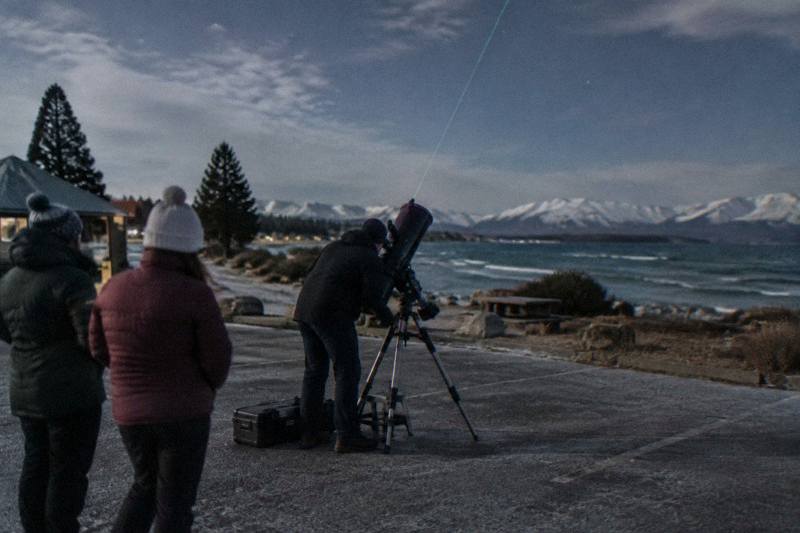
Can You See The Milky Way On A Lake Tekapo Stargazing Tour In A Full Moon?
A full moon dims the Milky Way over Lake Tekapo but brightens the Moon itself into a telescope highlight. Here is what each Tekapo, Twizel and Mount Cook tour can still show.
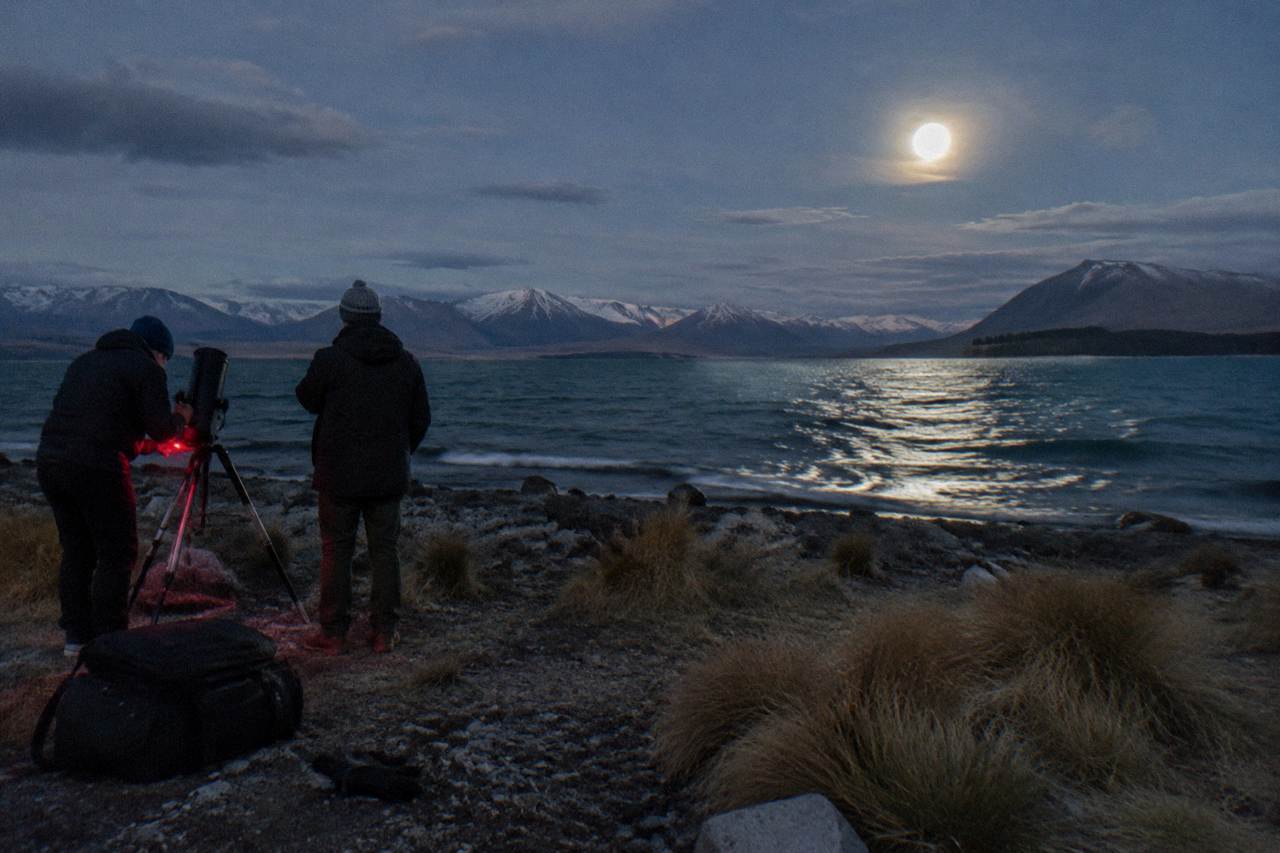
The honest answer is that the Milky Way's faint band largely disappears under a full moon at Lake Tekapo, so you should not book a tour expecting it that night. What you get instead is a Moon that is spectacular through a telescope: craters, ridges and terminator shadows in sharp relief, plus bright planets, star clusters and double stars that punch through the glow. Operators here say plainly that they cannot guarantee the Milky Way on any night, and moonlight is one reason why.
A full moon is the brightest natural object in the night sky after the Sun, and in the Aoraki Mackenzie International Dark Sky Reserve, a place protected since 2012 partly because of how dark it gets, the difference between a moon-free night and a full moon night is dramatic. On a moon-free night the Milky Way's glow can stretch across the whole sky. Under a full moon the sky looks closer to a suburban night: a handful of the brightest stars, and a washed-out horizon. Dark Sky Project, the operator based at 1 Motuariki Lane on the Tekapo lakefront, says it in its own FAQ: a new moon gives the darkest sky, and a full moon washes out faint stars and the Milky Way.
That does not make a full moon night a bad night to book. It changes what you are buying. A telescope tour on a bright moon night is a Moon tour, and the Moon through a decent instrument is genuinely striking. The choice matters most for photographers chasing the Milky Way band and for travellers who have one fixed night in Tekapo and want to know what to expect before they pay.
Why Does Moonlight Wash Out The Milky Way?
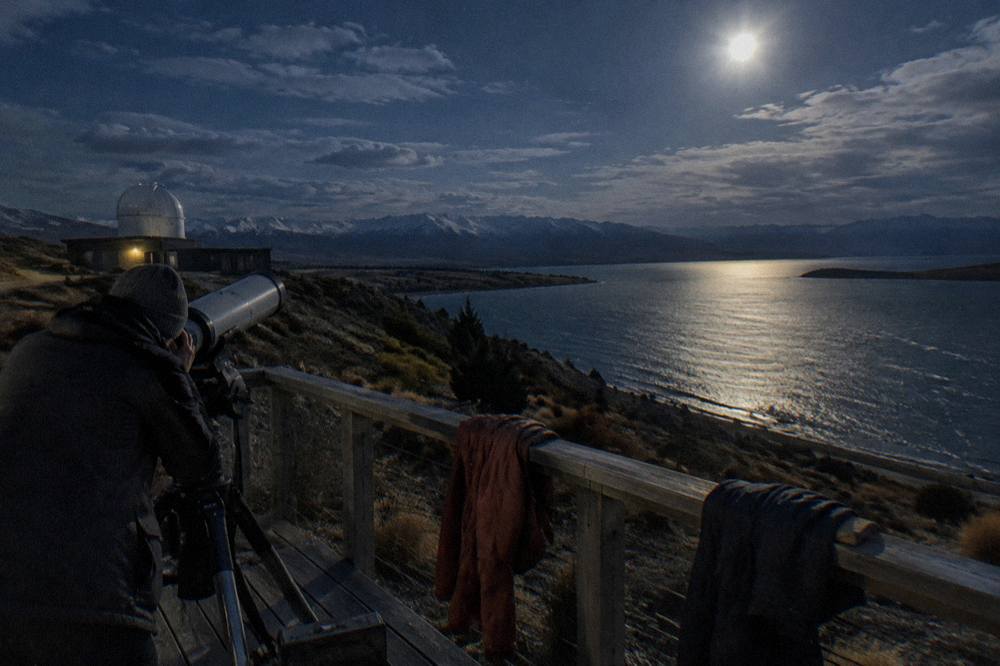
Moonlight washes out the Milky Way because it brightens the entire night sky, raising the background glow until it nearly matches the Milky Way itself. Since the Milky Way is the combined light of millions of faint stars, its glow is only barely brighter than a moonlit sky, so that small difference disappears and the band of stars fades from view. When the Moon is up and full, that background glow rises until the faint band sinks below it, leaving only the brightest individual stars visible. The effect is the same reason you see fewer stars from a city: it is not that the stars vanish, it is that the sky between them stops being black.
The numbers help. Astronomical darkness at the Tekapo lakefront means the Sun is more than 18 degrees below the horizon. In November 2026 that darkness arrives between 22:22 and 23:24 local time, and the sky stays properly dark for only 4.1 to 6 hours, so a summer full moon night gives you a short dark window with a bright Moon inside it. Around the June 2027 full moon, by contrast, darkness stretches about 11.3 to 11.5 hours, but the full moon of 19 June 2027 sits in that long window for much of the night. The Moon being up or below the horizon matters as much as its phase: a full moon that has not yet risen leaves a genuinely dark stretch of evening.
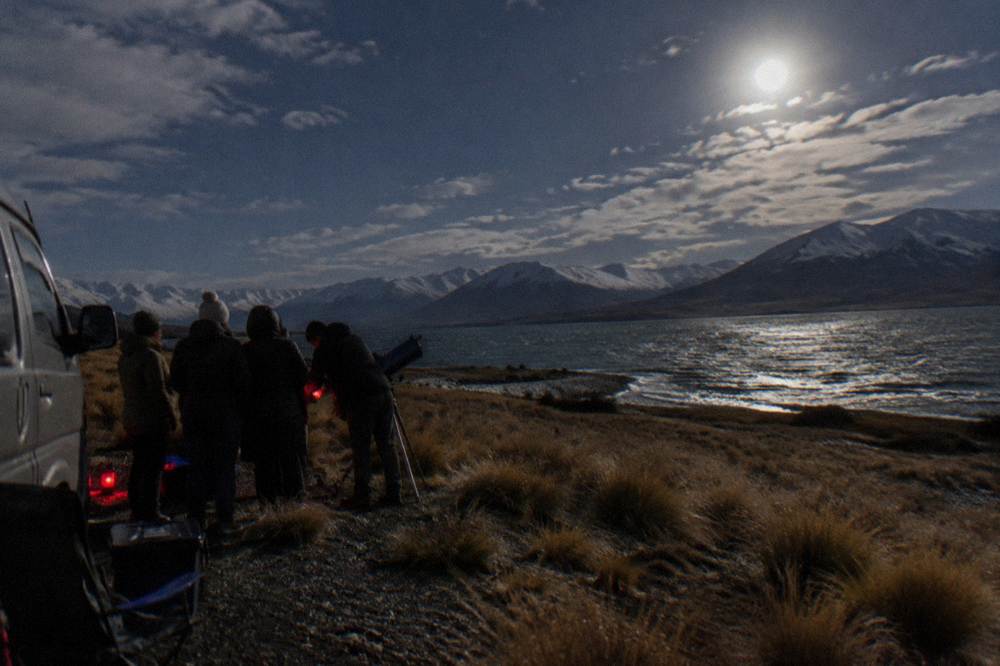
A full moon also rises close to sunset and sets close to sunrise, so there is very little dark, moon-free time either side of it. That is why the computed moon calendar for Tekapo tracks nights with three or more moon-free dark hours: November 2026 has 13 of 30, December 2026 has 12 of 31, and the count climbs to 21 of 31 in May 2027. On the nights around each full moon, that number drops to zero. For deeper background on how the reserve's protection works, the Aoraki Mackenzie dark sky reserve stargazing tours guide covers the district plan lighting rules that keep the baseline sky dark in the first place.
| Full moon (2026 to 2027) | Nearest new moon for the darkest sky | Moon-free dark nights that month |
|---|---|---|
| 25 November 2026 | 9 November 2026 | 13 of 30 |
| 24 December 2026 | 9 December 2026 | 12 of 31 |
| 23 January 2027 | 8 January 2027 | 13 of 31 |
| 21 February 2027 | 7 February 2027 | 15 of 28 |
| 22 March 2027 | 8 March 2027 | 18 of 31 |
| 21 April 2027 | 7 April 2027 | 19 of 30 |
Reading the table is simple: the full moon column is the hardest night for the Milky Way, the new moon column is the best, and the third column tells you how many nights each month give a solid moon-free dark stretch. If your trip falls across a full moon and you can shift a night or two either way, you can move from a washed-out sky to a dark one without changing anything else about your plans.
Can You See The Milky Way If There Is A Full Moon?
No, you generally cannot see the Milky Way's faint galactic band during a full moon, because the bright moonlight washes out the dim glow that makes it visible, and no honest stargazing operator at Lake Tekapo will promise you that view on a full moon night. Dark Sky Project states that a full moon washes out faint stars and the Milky Way, and none of the 12 tours covered here guarantees the Milky Way on any night, full moon or new. What survives moonlight at Tekapo is a different show: the Moon itself at high magnification, bright planets when they are up, colourful double stars, compact star clusters and, from a very dark reserve with even a partly moon-free sky, the brightest patches of the Milky Way around the core if the Moon is low or briefly set.
This is the question photographers ask most, and the answer is sharper for them. The Milky Way band that makes the famous arch-over-the-lake images needs a sky dark enough that the faint dust lanes record. Under a full moon, a long exposure brightens the sky before it captures the band, and the result is a grey frame with a few stars. If the picture is the goal, aim for the new moon windows and check the Lake Tekapo stargazing moon phase calendar before locking dates.
For visitors without a camera, the calculus flips. The Moon through a telescope is the object most people remember, and a full moon shows it at its most dramatic when viewed with a filter or when the terminator, the line between lit and unlit, throws craters into relief. A guide with a laser and a big telescope can also walk you through what moonlight is doing to the sky in real time, which turns the limitation into the lesson. On that point the Lake Tekapo Milky Way stargazing guide goes deeper on what the band is and when it can appear.
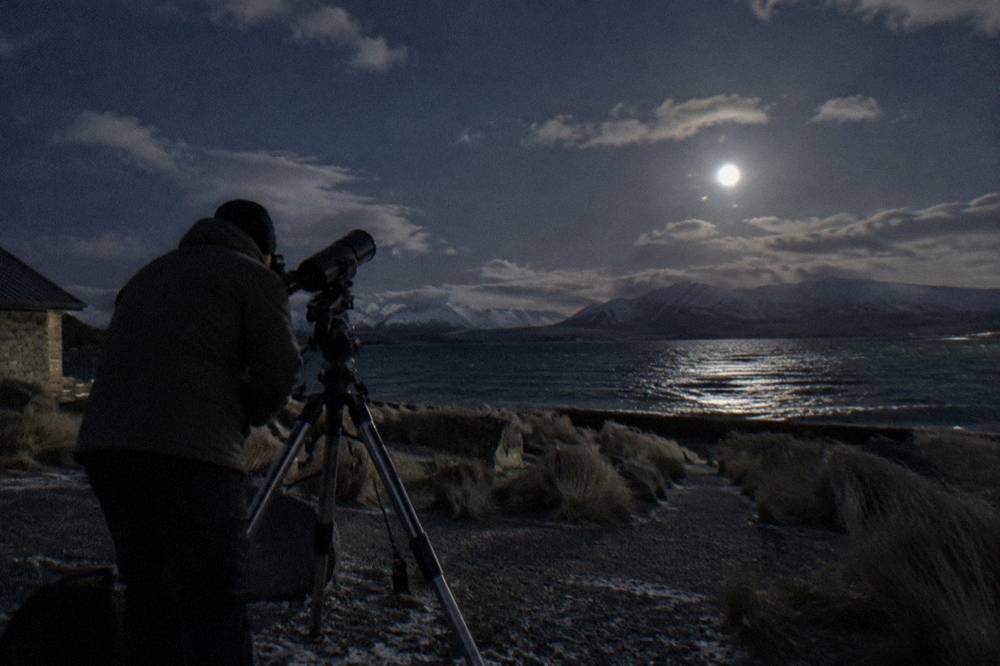
What Can You Still See On A Tekapo Tour During A Full Moon?
Plenty: the Moon at close range, planets like Jupiter and Saturn when they are above the horizon, bright double stars, open clusters such as the Jewel Box, and the two Clouds of Magellan on nights when the Moon is briefly low or set. A full moon removes the faint end of the sky, not the bright end. In a 9 inch or larger telescope, the Moon alone can fill an evening, and a guide who knows the sky can find the bright objects that hold up under moonlight one after another.
The tours at Tekapo handle a bright moon differently, and it is worth knowing the differences before you book. Chameleon Stargazing runs a 90 minute shared tour from 70 Andrew Don Drive, rated 4.9 across 789 reviews, from $73 per person, with a 9.25 inch telescope plus a smart telescope, a group capped at 14, hot chocolate and marshmallows, and a digital souvenir photo. Its format is about 30 minutes of naked-eye sky reading, which a full moon shortens in practice, then telescope time, which a full moon makes more interesting, not less.
Silver River Stargazing's Alpine tour, from $56 per person and rated 4.6 across 864 reviews, meets at 12 Rapuwai Lane before a shuttle to a private 50,000 acre farm site, with 14 inch telescopes, astro-lasers, warm down jackets provided and a complimentary digital photo. A 14 inch aperture gathers enough light that bright clusters and planets stay crisp under moonlight. The Ultimate Stargazing Experience from the same operator, 2 hours and a 16 inch telescope from $125.56 per person, rated 5.0 across 17 reviews, has a 16 inch telescope, the same aperture as the Summit dome, and aperture is exactly what helps on a bright night.
Astro Tekapo's Astro Experience, from $59 per person, meets at its own stargazing site in Takapo Regional Park, four minutes by car from the village, with a premium 9.25 inch telescope plus a smart telescope, a moon chair, a fleece blanket and hot chocolate. Its weather terms are its own: a full refund is offered if sky conditions are too cloudy for stargazing. Dark Sky Project's two outdoor tours, the Mount John Summit Experience from $135 and the Crater Experience at Cowan's Observatory from $78, both carry the operator's own cloud policy of an indoor alternative, a reschedule or a refund if outdoor stargazing is not possible. Moonlight is not cloud, though: these tours run on bright moon nights, and the view simply leans lunar.
| Tour | From (USD) | Rating / reviews | Telescope | What a full moon does for it |
|---|---|---|---|---|
| Chameleon Stargazing Shared Tour | $73.00 | 4.9 / 789 | 9.25 inch plus smart telescope | Naked-eye segment shortens, telescope segment gains the Moon |
| Alpine Stargazing Experience | $56.00 | 4.6 / 864 | 14 inch plus astro-lasers | Big aperture keeps planets and clusters crisp |
| Ultimate Stargazing Experience | $125.56 | 5.0 / 17 | 16 inch | 16 inch telescope for moonlit targets |
| Astro Experience (Astro Tekapo) | $59.00 | - | 9.25 inch plus smart telescope | Refund if too cloudy, Moon viewing otherwise |
| Mount John Summit Experience | $135.00 | 4.6 / 348 | Dome telescope at 1,029 m | Highest vantage, lunar viewing in the observatory dome |
| Hot Pools and Stargazing | $102.63 | 4.3 / 121 | Telescopes plus indoor virtual reality | Runs even under cloud, hot pools unaffected by moonlight |
One row deserves its own note. The Hot Pools and Stargazing night from Tekapo Springs, 90 minutes from $102.63, minimum age 10, is the least moon-sensitive of all of them: you are buying hot pools at about 38 degrees, a floating hammock, a woollen blanket and hot drinks, with guided stargazing outside the pools. Its operator's own policy is that the tour runs even if some or none of the sky is visible, with an indoor session instead, and a 25 percent refund applies if under 30 minutes of telescope viewing happens. On a full moon night that combination holds its value better than a pure sky tour, and it is the only tour of the 12 with hotel pickup from the Tekapo township, on request and subject to availability. The comparison is laid out in full in the hot pools versus observatory stargazing at Lake Tekapo guide.
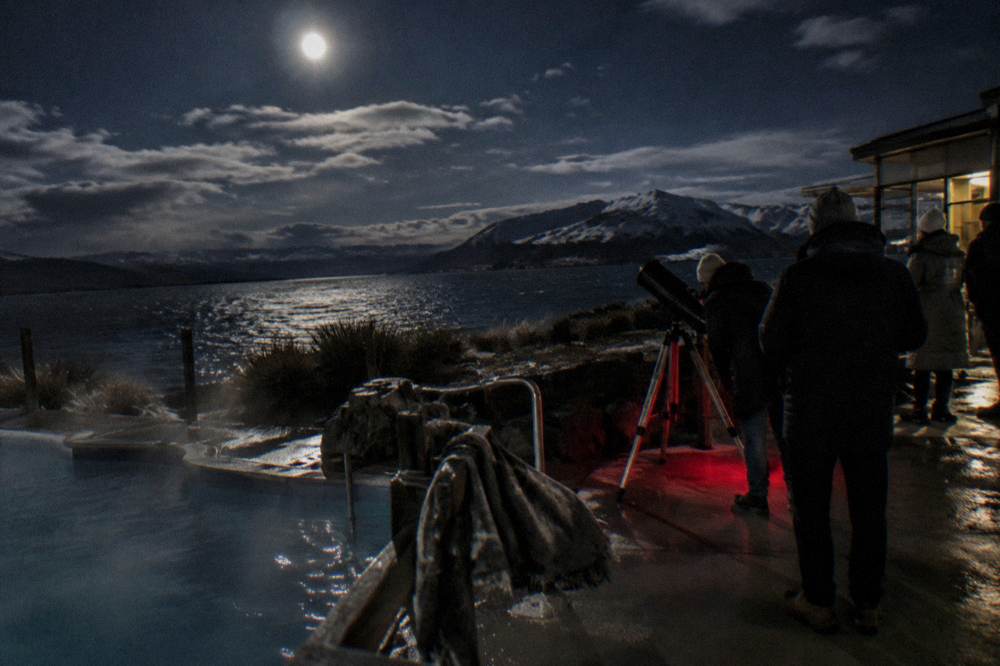
Is A Full Moon Night Good For Anything At Lake Tekapo?
Yes, a full moon night at Lake Tekapo is good for exactly two things: seeing the Moon itself, which stands out as a bright, detailed spectacle in its own right, and enjoying the moonlit landscape, where its glow gives the lake and surrounding scenery a soft, quiet character that darker nights can't match. A bright moon over Lake Tekapo lights the lake, the shoreline and the mountains enough to see them clearly without a torch, which is otherwise impossible in a reserve this dark. The Church of the Good Shepherd on the lakefront, a protected sacred site whose fenced grounds close at dusk, photographs by moonlight from the public paths outside the fence. And the Moon in a telescope, with craters and mountain rims in sunlight, is the single most detailed object available to any amateur instrument on any night of the month.
Moonlight also makes the practical side of a stargazing night easier. Walking a gravel path in the dark, finding your seat at a farm site, or stepping between telescope stations all become simpler when the landscape is lit. Travellers weighing comfort against darkness can lean on the what to wear on a Lake Tekapo stargazing tour guide for the clothing side, because the cold at Tekapo at night is real even in summer and only two of the tours covered here state that warm jackets are provided: the Summit Experience and Silver River's Alpine tour, each on its own booking page.
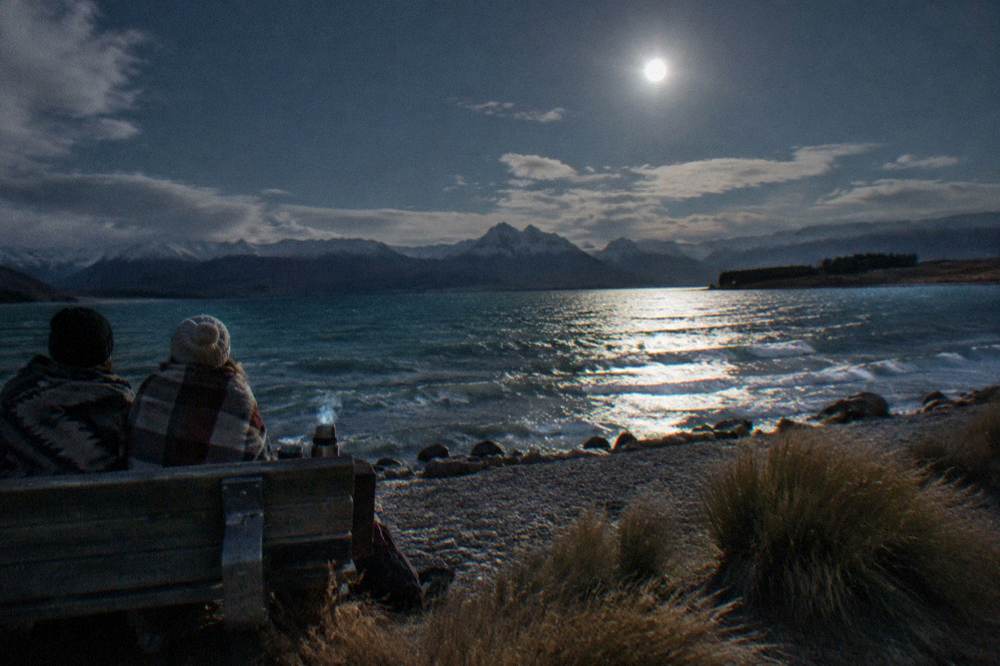
The trade is honest and simple to state. Give up the Milky Way band and the faint clusters, gain the Moon at high magnification and a landscape you can actually see. Some visitors enjoy the moonlit night more, particularly families with younger children for whom a pitch-black two hours can be a lot. Minimum ages vary by tour: 5 at Chameleon and at the Crater Experience, 6 at Astro Tekapo and at Stargaze Mackenzie's Twizel tour, and 10 at the Summit and the Hot Pools night.
Which Tour Works Best On A Bright Moon Night?
The Twizel Stargazing Tour with an Astronomer and Telescope is the strongest fit: a 5.0 rating across 77 reviews, from $67 per person, with a powerful telescope and a laser-guided guide who can build an evening around the Moon and bright targets. It runs 1 hour 15 minutes from 50 Kate Cameron Drive in Twizel, group-friendly from age 6, with a photo included. Its operator's terms are its own: it runs only in clear conditions, and if weather cancels you are notified and offered a refund or a reschedule. See the Twizel astronomer telescope tour page for dates, or Check availability.
An astronomer-led format earns its keep on a bright night because there is less sky to wander through and more to explain. The Moon invites narration: how the craters formed, why the terminator moves, why the same face always points at us. A guide who reads the sky well can also time the brighter objects around the Moon's height in the sky, and Twizel sits inside the same reserve as Tekapo with the same protected darkness underpinning everything.
The Mount Cook Stargazing Experience is the other natural fit. It meets at the Tasman Glacier Car Park in the national park, about 1 hour 15 minutes by road from Tekapo, from $56 per person, rated 4.8 across 17 reviews, with high-quality telescopes for deep sky observation and a photo included. Under a full moon, "deep sky" thins out and the bright solar system objects carry the night, but the setting, glacier country under moonlight, is its own argument. The Mount Cook stargazing tour guide covers what changes when you start outside Tekapo, including that there is no transfer from Tekapo: you make your own way to the car park.
Whichever you choose, all 12 booking pages state free cancellation up to 24 hours before the start for a full refund. That matters on moon nights, because the one thing you cannot cancel is the Moon: if your fixed date lands on a full moon and the Milky Way is the goal, a tour with flexible dates beats a tour with a perfect telescope. More on the booking-timing question sits in the do I need to book a Lake Tekapo stargazing tour in advance post.
Should You Book A Full Moon Night Or Shift Your Dates?
If the Milky Way is the reason you are coming to Lake Tekapo, shift your dates to a new moon window instead of booking a full moon night. The difference is not subtle: it is the difference between the Milky Way band being visible and being invisible, so keep a full moon date only if the stars are not your priority. If your dates are fixed, book anyway, choose a telescope-led tour, and treat the Moon as the headline. And if you are undecided, remember that weather, not the Moon, is what actually cancels nights, and the operators' cloud policies differ tour by tour.
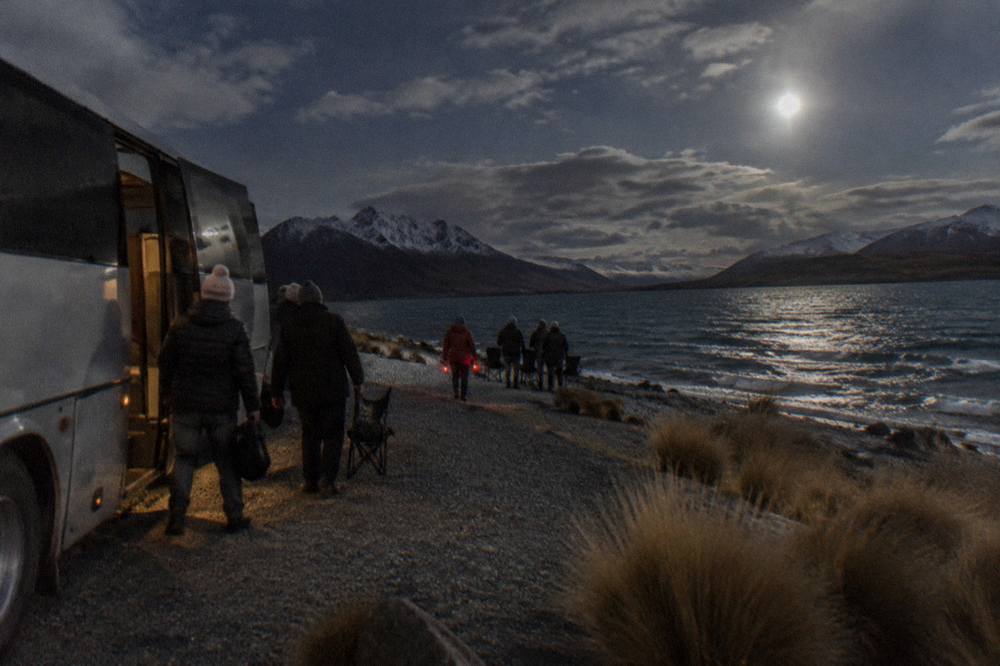
The most useful planning move is a two-minute date check. Count forward or back from the full moon dates above, and look at whether the Moon is up during the hours of darkness. Even three or four nights either side of full gives you a stretch of dark, moon-free evening before moonrise, and by a week after full the second half of the night is dark. The full sky returns around the new moon dates: 9 December 2026, 8 January 2027, 7 February 2027 and onward through the calendar. For a broader view across the seasons, the Lake Tekapo stargazing winter versus summer guide weighs long winter darkness against summer's very late, short dark hours under NZDT, which this year runs to early April 2027.
There is a final point worth making about expectations, and it is the one this site exists for. The Milky Way can be visible from Lake Tekapo on dark nights when the moon is down and cloud allows, and that is exactly why a full moon night feels like such a contrast. Operators here do not oversell it: Dark Sky Project says outright it cannot guarantee clear skies, the Milky Way or the Aurora Australis. Booking a tour on a full moon night with the Moon as your target is not a consolation, it is a different, smaller, and in the telescope genuinely impressive show, and knowing which one you are buying is the whole decision.
Common Questions About Full Moon Stargazing At Lake Tekapo
Can You See The Milky Way If There Is A Full Moon?
No. A full moon brightens the sky enough to wash out the Milky Way's faint band, as Dark Sky Project's own FAQ states. On a full moon night at Lake Tekapo you see the Moon, bright planets, double stars and clusters instead, and the Milky Way returns as the Moon wanes or sets.
When Is The Next Full Moon At Lake Tekapo?
The next full moons fall on 25 November 2026, 24 December 2026, 23 January 2027, 21 February 2027 and 22 March 2027. Those are the hardest nights for the Milky Way and the best nights for viewing the Moon through a telescope.
Which Nights Are Darkest For Stargazing At Lake Tekapo?
The nights around each new moon, when the Moon is below the horizon: 9 December 2026, 8 January 2027 and 7 February 2027 among upcoming dates. November 2026 offers 13 nights with three or more moon-free dark hours out of 30.
Do Stargazing Tours Still Run On Full Moon Nights?
Yes, moonlight alone does not cancel tours; cloud does, and each operator sets its own weather terms. All 12 booking pages state free cancellation up to 24 hours before the start for a full refund, and weather policies, such as reschedule or refund offers, belong to each individual operator.
Is The Moon Worth Seeing Through A Telescope At Tekapo?
Yes. Through the 9.25 to 16 inch telescopes used on these tours, a full or gibbous Moon shows craters, ridges and shadows in striking detail, and many guides add astrophotography tips. Photos are allowed on the Mount John Summit Experience with the flash off.
What Else Can You See On A Full Moon Stargazing Tour?
Bright planets when they are up, colourful double stars, open clusters and, when the Moon is low or briefly set, the brightest parts of the Milky Way and the Clouds of Magellan. A guide with a laser can also read the moonlit landscape and the bright constellations that survive the glow.